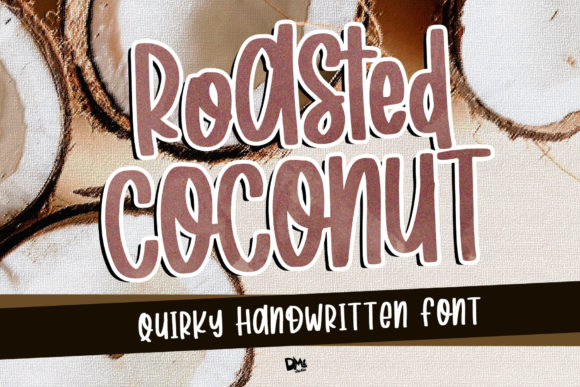
Roasted Coconut: A Bold Script for Real Projects
As a designer who’s worked with countless fonts across various projects, I’ve come to appreciate the importance of a typeface that not only looks good but also functions well in real-world scenarios. Roasted Coconut, part of the Script Amp collection, is one such font that demands attention. Its unique character and expressive style make it a standout choice, but like any creative tool, it requires thoughtful application.
The First Impression: Warmth and Personality
Roasted Coconut immediately conveys a sense of warmth and authenticity. The fluidity of its strokes and the subtle irregularities in its curves give it a handcrafted feel that feels both modern and nostalgic. It’s not just a font—it’s a visual mood. This script has a personality that leans toward casual, artisanal, and slightly playful, making it ideal for brands that want to communicate approachability and creativity.
Its visual weight isn’t too heavy, which means it can be used in a variety of contexts without feeling overwhelming. The contrast between thick and thin strokes adds depth, while the ligatures and flourishes create a sense of movement and energy. It’s a font that invites you to lean in and take a closer look.
Real-World Use: Where Roasted Coconut Shines
In logo design, Roasted Coconut can be a strong choice for brands that want to convey a personal or craft-oriented identity. It works especially well for food-related businesses, boutique brands, or creative studios looking to stand out. However, it’s important to balance its expressiveness with clarity—especially when paired with other elements in a logo.
For brand identity, this font can serve as a key element in a typography hierarchy. It’s best used in headers, subheaders, or as a decorative accent rather than the main body text. When integrated thoughtfully, it can add a human touch to a brand’s visual language, helping to build emotional connections with the audience.
In packaging design, Roasted Coconut can elevate the aesthetic of product labels, especially for items like coffee, baked goods, or handmade crafts. Its organic flow complements natural or rustic themes. But again, testing it at scale is crucial—large headlines may require adjustments to maintain legibility and visual harmony.
When used in web design, Roasted Coconut can enhance website headers or hero sections, adding a unique flair that sets a site apart. However, designers should be mindful of load times and ensure that the font is optimized for digital use. It’s also wise to pair it with a complementary sans serif or serif font for better readability in longer text blocks.
Where to Be Cautious: Limitations and Best Practices
While Roasted Coconut is a strong display font, it’s not always the best choice for large headlines or long paragraphs. Its intricate details can become lost at smaller sizes, reducing readability. For supporting text or body copy, a more structured typeface would be more appropriate.
It also requires careful pairing. Using it alongside a serif or sans serif font can help balance its whimsical nature. For example, pairing it with a clean, modern sans serif can create a nice contrast that enhances the overall design. Similarly, using it alongside a handwritten or script font might lead to visual clutter if not done intentionally.
For premium packaging or high-end branding, Roasted Coconut may not always convey the level of sophistication expected. In those cases, a more refined script or a minimalist display font might be a better fit. That said, for niche markets or artisanal brands, its charm can be an asset.
Readability, Hierarchy, and Brand Consistency
One of the most critical aspects of any font is its readability. Roasted Coconut performs well in short phrases and headlines, where its expressive qualities can shine. However, when used in larger blocks of text, it can become difficult to read, especially for audiences with visual impairments or in low-light environments.
Designers should test Roasted Coconut in black and white to see how it holds up without color. Sometimes, the subtleties of a script font are lost in monochrome, which can affect its impact. Also, checking small-size readability on screens and print is essential—what looks great at 72pt might not work at 14pt.
Consistency is another factor to consider. If Roasted Coconut is used throughout a brand’s assets, it should be applied uniformly to maintain a cohesive look. Overusing it can dilute its effect and reduce its effectiveness as a signature element.
Practical Designer Notes: Testing and Pairing
Before finalizing any project with Roasted Coconut, I recommend testing it in real mockups. See how it interacts with other design elements, and don’t hesitate to tweak spacing or line height for optimal results. Comparing it to other fonts—such as a serif, sans serif, or another script—can help determine the best fit for your project.
Also, check the commercial licensing terms. While Roasted Coconut may be a creative font, ensuring it’s properly licensed for client or business use is a must. This applies especially to digital products, printable designs, or Canva templates where the font might be shared or distributed.
Finally, remember that less is often more. Roasted Coconut is a bold choice that can add personality and visual interest, but it should be used with intention. Whether you’re working on a logo, a social media graphic, or a digital ad, understanding the context will help you make the most of this expressive script.
Conclusion: A Creative Tool with Purpose
Roasted Coconut is not a font for every project, but for the right ones, it can be a powerful asset. It brings warmth, character, and a sense of authenticity that many other fonts lack. As a designer, I appreciate its ability to add a human touch to digital and print work, especially when used with care and intention.
If you’re looking for a script font that can elevate your branding, packaging, or editorial design, Roasted Coconut is worth considering. Just remember to test it thoroughly, pair it wisely, and use it where it will have the most impact. With the right approach, it can become a valuable part of your design toolkit.